


All paid-up members of the Leicestershire Repeater Group (for whom we hold an email address) should have received an email with their unique username and password to access the members private area of the website.
This area contains access to many back issues of LENS - "The LE News Sheet". This is only available to paid-up members.
If we don't hold an email address for you or you have not received your registration email, please contact
Just the mention of the call sign G5UM or the name 'Uncle Mike' immediately brings the name of Jack Hum into the conversation. He was recognised as a man full of drive and energy who pioneered and popularised the VHF and UHF Bands in United Kingdom, everybody seemed to know Jack wherever you went.
Jack Hum, the father of amateur radio in Leicestershire, died at his home on January 11th, 1995. He was 84 years old and his passing will he mourned by the whole of the Amateur Radio movement.
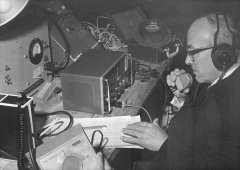
He was licensed in October 1927, a few days before his seventeenth birthday (and his Dad had to pay the bill because he was still a minor). Jack waited in eager trepidation for the arrival of the new callsign. He guessed it might be 5JH, knowing this callsign had not been allocated and also knowing the license authority of the day had a penchant for issuing self-evident callsigns. He never expected to receive 5UM: that callsign, he thought, belonged to a chap in East London. What he did not know was that this man had given up when the spark went out. So JH received a callsign only one dot more than his surname in the Morse code, without even asking.
Note no "G" prefix. You needed a special dispensation from those on high if you proposed to work stations outside of these islands, and that didn't come until later where 5UM was concerned. His earliest years were devoted to 160 metres simply because that was the easiest and cheapest band on which to get started. Operation was mainly on c.w., because modulation techniques of the day were rudimentary involving placing a carbon microphone in the earth lead, and r.f. burns to the lips were not unknown.
The first introductions to "the very highs" came via the rushbox mode of self-excited oscillator, again modulated by the carbon mike, and super-regenerative receiver. The bandwidth of both devices was indeterminate and really didn't matter in those days of 56MC/s (before Megahertz's came in). Ranges were short, performance minimal, but you made it yourself, including the aerial and it was all great fun.
Then came the war and Jack served in the Royal Air Force on communications, rising in rank to a Squadron Leader on Coastal Command duties.
After the great resumption of amateur radio in 1945, rigs had to be stable and crystal controlled. The few dozen people you heard on the then 58 - 60 MHz bands could immediately be identified by the crystal frequencies they used: you didn't need to wait for their callsigns.
"Uncle Mike" recalled that it was a great moment when he achieved his first ever QSO on 2m. The receiver was a TRF. The transmitter had just been completed and the output coil was thrust into the tank inductor and held there while a CQ was pounded out. No wonder G5MA at the other end reported QSB: it was Jack's hand shaking with excitement as he held the antenna coil lethally against the tank coil.
In 1952 G5UM was elected to the RSGB Council in an office (long since abolished) called Hon. Editor. In the company of others, notably the late G2UJ, he attempted to install some recognition of the "very highs" into the then hierarchy of the national society. Thus was born the VHF National. Field Day, the new VHF Committee, and the concept of amateur band beacons to provide indications of conditions.
After eight years on the RSGB Council, Jack stepped down at the end of 1959 and looked forward to a few years of freedom to get on with a bit more constructional work. However, this was a short-lived hope: in 1966 he was invited to take over the MetreWave Column in the national society's journal, and this he wrote until he was compelled for health reasons to relinquish in 1975. He gave up the secretaryship of VHF/UHF Awards Manager, which was passed on to him by G3GMY in 1966.
Another significant and fascinating development, which involved the society's VHF committee in the early Seventies, was to get the repeater concept "off the ground." Tentative at first, with just the one GB3PI repeater at Cambridge, the repeater movement now covers the UK, It was, Jack exclaimed at the time, the biggest collective movement and the Leicestershire Repeater Group represents one of its most shining examples.
It was in 1966 when Jack left Murphy Radio headquarters and came to Leicester to join Rank Taylor Hobson as their Technical Journalist. He and his wife Grace wisely chose a house on the highest and best VHF location in the county at Houghton-on-the-hill.
In 1974 G5UM was one of three members to be presented with Vice Presidents' badges at the RSGB Annual General Meeting of that year. This was for services rendered to VHF.
In Leicestershire Jack was very proud of two honours bestowed on him. In 1985 he was elected Honorary Life President of the Leicestershire Repeater Group and was also President of the Leicester Radio Society. The walls of his shack were lined with certificates and awards that he had gained in his hobby. In all this he was supported by his wife, Grace, who survives him.
Many people have described Jack Hum as the "great gentleman of the airwaves" and he was too and nobody will ever take his place. The standards he set us will be forever remembered by the amateurs who knew him. He was at his happiest when he was in the company of amateurs or in a net on six metres, four metres, two metres or seventy centimetres.
On the day he died his logbook was open on his operating table, meticulously made up, with the last contact dated the day before.
Jack kept detailed records of all his contacts, including hand-written textbooks listing all the owners of pre-war callsigns, something the RSGB Library had been searching for. Over five thousand callsigns with names and addresses were listed. After his death these records were put on a computer disk and are now known as the 'Jack Hum Call book'.
Deryk Wills G3XKX.
{backbutton}
The transmitter consists of a Worthing group TX + P.A. Block (M57762 Brick) feeding an Alford slot antenna through an inter digital filter. The receiver is a Wood and Douglas 24cms down converter + VDIF fed via a second Alford slot and inter digital filter the antennas are separated in height by about 6 feet RX being the heighest.
The logic control of GV consists of a conventional video sync detector circuit (NE556 IC) which is used to control a video / audio switching IC. Selecting the off air signal or beacon mode images. It is also used to flag the status of the repeater's receiver to a 386 PC that simultaneously generates pictures / captions, provides Morse ident, continuous tone and logic control. A video converter card installed in the PC provides all Pictures and captions seen on GV.
The PC controls many other features of GV including the access caption and Morse "K". When engineering work is taking place on site it is also used to generate announcements etc.
How the PC is used to control GB3GV
When power is first applied to the PC a self-executing programme is started. The picture magazine seen on GV's output is loaded from the hard disk to a RAM disk. (Changes to the picture magazine normally taking place on the first day of each month, or when there is a special event, rallies Christmas etc). Using this method pictures are stored on the hard disk months in advance of them being required. Once every twenty four hours during the early morning the PC is auto reset ( rebooted ). The control programme is reinstalled, the PC's internal date is then checked and the appropriate picture magazine is loaded. Having a reboot each day has the advantage that should the PC control programme crash or the PC locks up then a restart and reload of the control programme will rectify this. Since the introduction of a PC at the repeater site, and with the severe fluctuations in the mains supply that have been noted, I do not think there has been a single case of a programme crash, just reboots due to total loss of power.
When all the pictures have been loaded to RAM disk then the hard disk is stopped. It will not be required again until the next reboot running the hard disk continuously is not necessary as it's only required at boot-up.
During loading the Video output is blanked to stop the loading process being seen on GB3GV's output. When loading is complete and GV is running in beacon mode, each picture is displayed for approximately 1 minute, the current magazine consisting of approximately 16 pictures. This number is limited only by the size of the RAM disk currently set at about 7Mhz.
All pictures and captions seen on GV are obtained from standard image file types. They are obtained from photos through a picture scanner or by a video frame grabber, if not already in a 640 x 480 resolution then they are converted to this standard. A higher resolution is not required for high quality 625-line colour television.
The pictures can then be edited and GB3GV's call sign is inserted and any other text added as necessary, each image is then turned into self-executing file.
With the above method it is possible to have new pictures installed on GV on a regular basis. Even a change of magazine could be initiated on a day to day basis, but for me to visit the repeater site requires a round trip of about 20 miles, consequently visits to site are limited. The time taken to collect suitable pictures, edit them, prepare for the repeater and to visit the site once a month is a lot to do. Updating of the picture magazine could be done over the air but suitable safeguards would be required to stop unauthorised access etc.
The above method of controlling GV has proved very reliable.
I have many ideas for future addition's ie a live site camera / video recorder a 10 GHz link or even video frame capture through the PC. All this should be possible, but it takes time and money. As stated above, with so few users it is already taking proportionately more of the groups' resources to run then any of the other devices on site. Many ATV stations in surrounding counties have commented on the lack of activity.
So please anyone who is active with ATV and can access GV, members of the group or not. Please use it or lose it!
73 de G8OBP
From David
{backbutton}
Registered users can use this page to renew their subscription to The Leicestershire Repeater Group

This is reproduced here from the website of Dave Cushman G8MZY www.dave-cushman.net
I took over a somewhat sick repeater (29 March 1981, at a Sunday afternoon AGM) The repeater had a transmitter producing a few milliwatts and a receiving system that had been deafened by water in the aerial baluns and water dripping out of the bottom end of the aerial feeder. Some tweaking of the cavities 'by ear' of well meaning, but ill informed 'helpers' also rendered the system somewhat deaf.
I fished the TX out of the hole and was given a quick tutorial by Geoff G3TQF, the original builder of the PA, on what was wrong and how to put it right. When repaired the TX was soaked overnight at 20 watts into a dummy load and as no further problems manifested themselves I took the TX to the GPO 'radio interference' lab (who had better test gear than I did) for a full check on spurious emissions.
Back down the hole with a mountain of test gear and a flask of hot soup, ably assisted by some well equipped out stations that provided calibrated signals and the machine was back on the air. At the time that this work was going on some hash was found on the 12v DC busbars and I resolved to isolate 'LE from the rest of the LV system by means of filters.
The original Hexalator was minus it's case and lying in a dusty heap on the bench. Using an aerosol can of solvent cleaner, the dust was blasted off and when the volatile liquid had evaporated, the unit was encased in the plastic bag that my lunchtime sandwiches had been in. (Not the first time that Leicester's UHF repeater's bits and pieces had been protected in this fashion.)
{backbutton}
Page 2 of 5